

The EU's Smart Readiness Indicator: is your home ready for the 2026 deadline?
For years, "smart" was a marketing word. In 2026, it's becoming a regulatory one. Quietly, in the background of Brussels policy documents, the European Union has been building a scorecard for exactly how "smart" a building really is — and the results of years of testing are due to land this year.
What the Smart Readiness Indicator actually measures
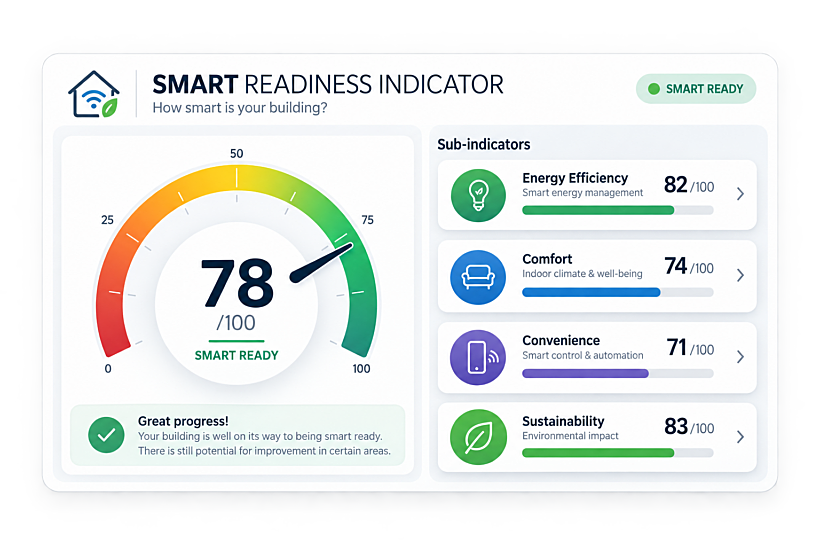
The Smart Readiness Indicator (SRI) is part of the revised Energy Performance of Buildings Directive (EPBD). Rather than only asking "how energy-efficient is this building on paper," it asks a more practical question: can this building actually adapt its heating, cooling, lighting, and electricity use to the people living in it — and to the grid outside it?
In practice, the SRI scores a building across domains that will sound very familiar to anyone who has looked into home automation: heating, hot water, cooling, ventilation, lighting, dynamic shading, electricity and EV charging, and — crucially — monitoring and control. A building only scores well if these systems don't just exist, but talk to each other.
Where things stand right now
Testing of the SRI has been running since 2022 across sixteen EU countries, including Belgium. By 30 June 2026, the European Commission is required to report to Parliament on how that testing has gone. That report feeds directly into a delegated act, expected in 2027, which will make the SRI mandatory for large non-residential buildings first — those with HVAC systems rated above 290kW — before rolling out further.
This sits alongside the EPBD's broader energy performance timeline: non-residential buildings need at least an E-rating by 2027 and a D-rating by 2030; residential buildings follow with an E-rating by 2030 and D by 2033. Smart readiness and energy performance are being pulled into the same conversation, not treated as separate boxes to tick.
Why this matters if you're not a facility manager
It's tempting to read "non-residential buildings over 290kW" and assume this is someone else's problem. It isn't, for two reasons. First, residential SRI frameworks are actively being shaped by the same test phase — homes are next. Second, and more immediately: a home that already meets these criteria has a real, documentable value advantage as the market catches up to the regulation, not after.
A rough self-check
Before an official assessment ever reaches your street, it's worth asking the same questions the SRI does:
- Can your heating and cooling respond to whether a room is actually occupied, not just a timer?
- Can your lighting and shading work together to manage both comfort and energy use?
- Is your electricity use visible to you in real time, and can any of it shift automatically toward cheaper or greener hours?
- If you added an EV charger tomorrow, could your system manage it intelligently, or would it just be one more plug drawing power blind?

The advantage of building on an integrated system
This is precisely the gap that a professionally installed, bus-based system like KNX was built to close. Because heating, shading, lighting, metering, and increasingly EV charging all sit on the same backbone rather than in separate branded apps, a KNX-equipped home tends to already satisfy most SRI domains by design — not because it was built for a regulation that didn't exist yet, but because integration was always the point.
A concrete example
Say you're planning to renovate your kitchen or replace an aging boiler this year: either project is a natural, no-extra-cost moment to also route your heating, shading, and metering onto one shared system, rather than automating the kitchen in isolation and rewiring everything again in five years when the next domain becomes mandatory.
What to actually do now
Ask your installer for an informal "smart readiness" walkthrough alongside any renovation quote. Most integrators can map your home against the SRI domains today, without waiting for it to become mandatory.
Run a one-week test: does your heating actually drop when a room sits empty for hours? If not, that's your weakest SRI domain, and usually the cheapest one to fix first (a presence sensor and a smart valve, not a full system overhaul).
Building new or doing a deep renovation? Ask specifically about EV-charging readiness even if you don't own an EV yet. Retrofitting the electrical capacity later is far more disruptive than provisioning for it now.
Keep an eye on your national energy agency's timeline. Implementation details (and any national incentives) will differ per country as the EU's 2026 report feeds into local rollout plans.
The takeaway
The SRI won't show up as a sticker on anyone's front door this year. But 2026 is the year the EU moves from testing the idea to deciding how to enforce it. Homeowners who treat "smart" as a genuinely integrated system, rather than a collection of independently smart gadgets, won't need to scramble when that happens. They'll just need someone to fill in the paperwork.